You can spend a weekend watching AI videos and still feel stuck on Monday morning. You have seen someone else click through a tool. You have not done it yourself, on your own work, with someone there when you get stuck.
That is a common place to land. You open a chat box, type a few questions, get a few answers, and go back to doing the work the old way.
Action AI went back in time. Back to class.
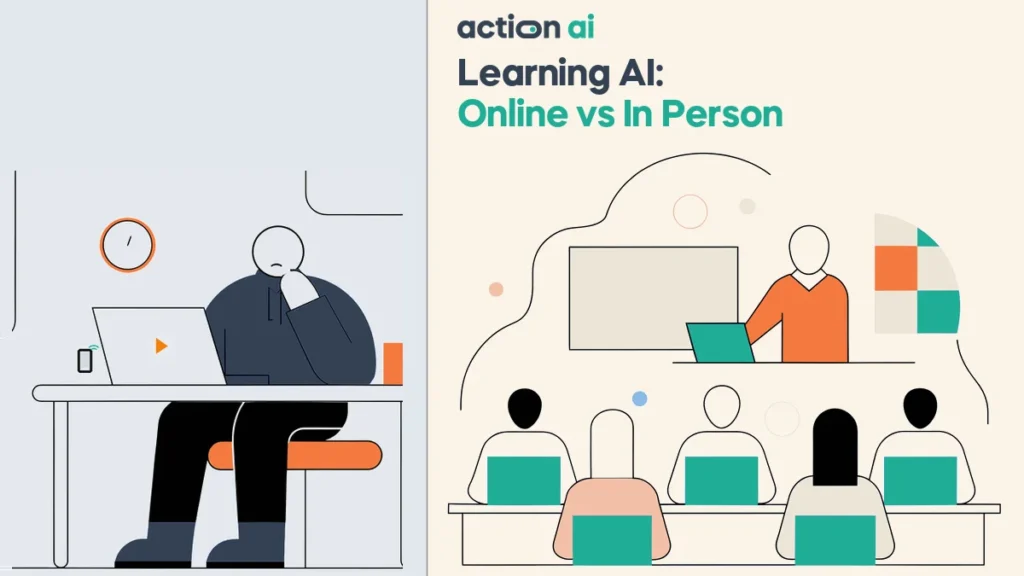
When you are in a room with your laptop open, doing the work as you learn it, it is harder to drift. A small group and a live instructor change how that hour is spent. That is a different experience from a YouTube video, or from a recorded course you bought and never quite finished.
You can learn all of this on your own, online. The tools are public. The tutorials are everywhere. Plenty of people figure it out that way.
What changes in class is how you spend the time. You spend it building the thing, on your own files, while an instructor can see where you got stuck and help you through it.
This is where hands-on learning in Toronto and across the GTA earns its place. It works in a boardroom with a team, and in a small public class with individuals and entrepreneurs. It also works live online, in a small group, for people who cannot get to the room. The method is the same. Being there in person is the strongest version of it.
Why the room still works
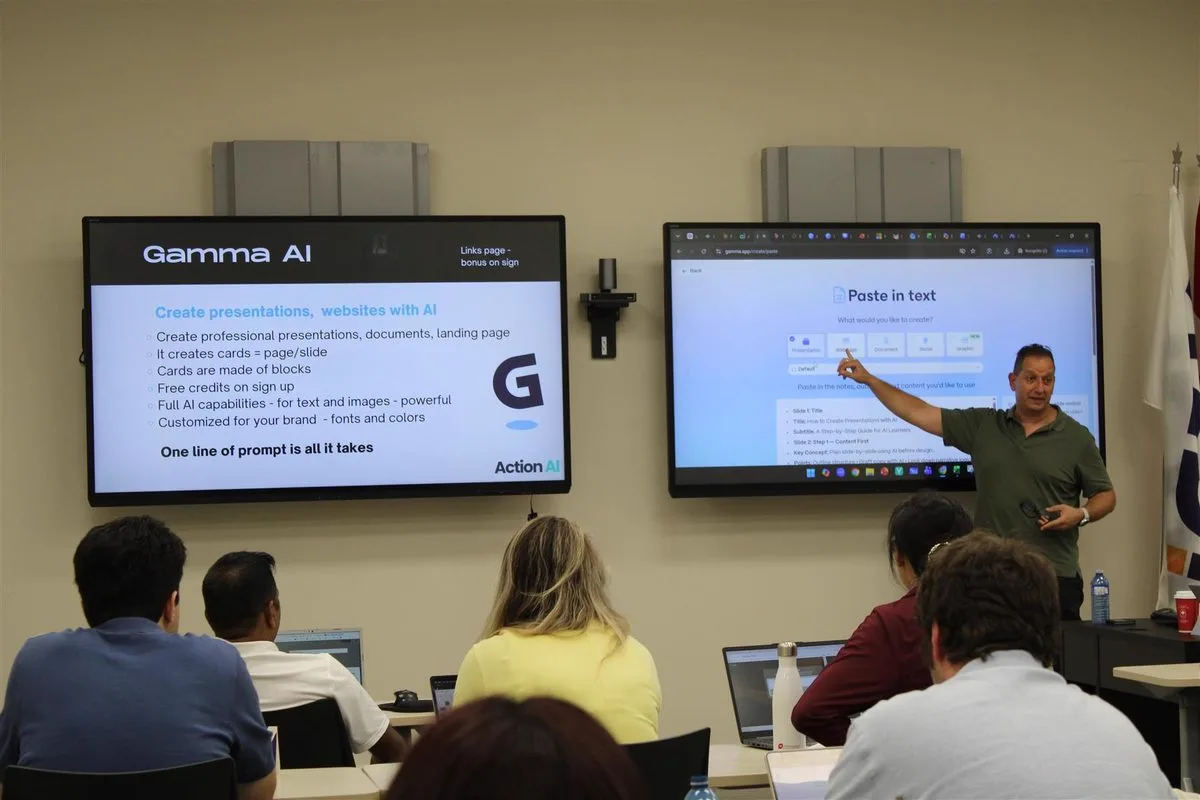
In a live class, your laptop is open and the next step is yours to try. If it does not work, you can ask right then. You learn better when you actually get to do it. That simple loop is what makes the skill stick.
A video is easy to leave running in another tab. A recorded course can sit unopened for months. That happens to busy people. There is no one there with you, and no one expecting you to do the work that day.
A small group makes the help real. The instructor can look at your screen and deal with the one thing that is blocking you. Action AI keeps public in-person classes to a maximum of 12 people so that can happen. The live online course is capped at 8. For team training in your office, the hands-on format is for up to 15 people.
You can learn this alone
Everything taught in a class like this can be learned alone, online. That is worth saying plainly. There is no secret tool that only exists in the classroom.
Class gives you a place to practise, and a person who can steer you when the tool does something you did not expect. You leave having built something you can use the next morning, on work that already belongs to you.
This is also how a hands-on session differs from a theory-heavy bootcamp. Those programs can spend a long time on how the models work, before anyone opens a real file. In a hands-on session you open the tool and do the job on a real file of yours, like a document you need to rewrite or a task you already repeat each week.
Building real work, together
People enjoy this format because the work is theirs. A marketing team can bring a campaign they are actually running. A business owner or a freelancer can bring a messy draft or a file they have been avoiding. You practise on work from your own week.
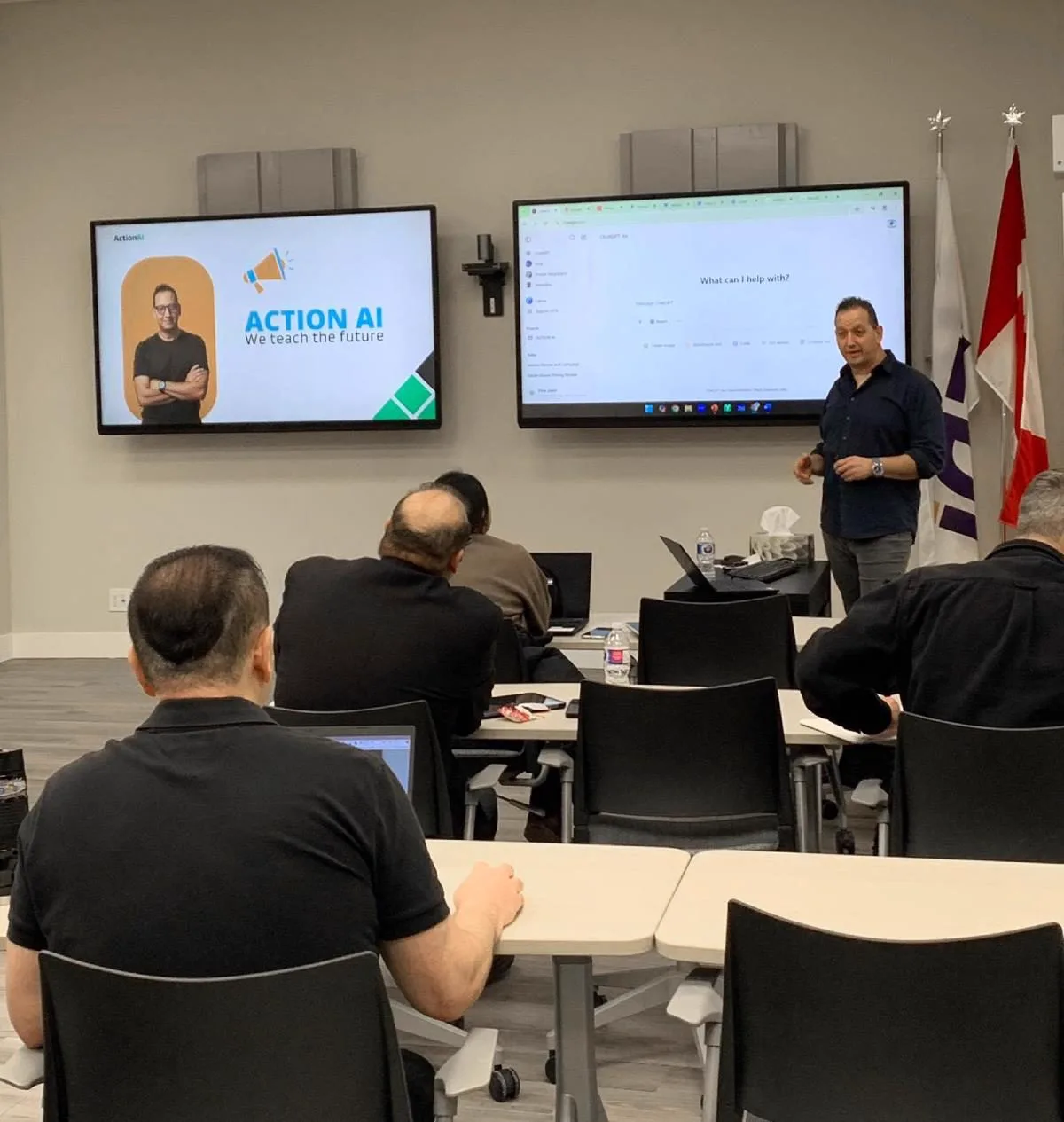
Claude is part of what Action AI teaches. In its AI course in Toronto, people use Claude and ChatGPT to write faster and more clearly. For a team that wants Claude training in Toronto, a half day can go deep on that one tool, especially for long documents or a task the team already repeats. The training also covers other tools a business may already pay for. The point is to build something useful in the room.
There is something special about being in a boardroom with a team, building the work together, or in a class with individuals and entrepreneurs who are trying it on their own businesses. The room gets focused. People ask the question they have been carrying around. Then they see their own task get easier, in front of them.
What an AI course in Toronto looks like
If you want this for yourself, Action AI, founded by Toronto AI trainer Ran Armon, runs an in-person AI course in Toronto: four evening sessions in a small group. You do not need a tech background. You learn by doing, with an instructor beside you.
If you are looking for hands-on AI training for small business teams in Toronto, we come to your office, anywhere in Toronto and the GTA. That can be ninety minutes in your boardroom, or a half day that goes deep on one tool.
If you cannot get into the room, the same four evening sessions also run as a live online AI course in Canada, in a small group, with a live instructor. You practise and ask questions in the moment. In person is the strongest version, because the instructor can walk the room and see each screen. The live online format is still a real class, and it is there for people across Canada who want the same method.
If that sounds useful, start with the page that fits you, and come ready to work on something real.
Work Smarter, Not Harder.